Monday, July 19, 2010

True Love


With heartfelt apologies to miscellaneous boys of Fulton, New York, I think it's fair to say that my first true love was a Volvo 240 DL.


A 5-speed.

In dark green.

As a result, I had high expectations for this past weekend in Stockholm.

John had a week-long conference there, and I joined him on Friday evening via a mildly arduous bus-to-train-to-bus-to-discount-airline-which-I-always-swear-I-am-never-using-again-to-bus-to-subway journey.

But much to my chagrin, Sweden is not crawling with Volvos of that glorious 1980s vintage.

Most of the Volvos that I saw were newer-model station wagons, which just don't have that same boxy allure.

However: many of them were tricked out with elaborate rearview mirror extenders for the pop-up campers they were towing.

Which made up for it, sort of.

Another major consolation is that one can purchase an extensive array of Volvo advertisement postcards in Stockholm.

This resulted in a rare instance in which John probably should have imposed a budget prior to letting me enter the store.

Calamitous Volvo shortages notwithstanding, Stockholm turned out to be a really fun place to spend the weekend.

I liked a lot of things about the city, but my favorite part was that it has a vaguely 1970s socialist aesthetic, paired with a passion for bleeding-edge art and design.

As an added bonus, the Swedish language is hilarious.

Dear Lovely People of Sweden: when I say that your language is hilarious, I mean that in the nicest, most respectful way possible.

It's just very, very difficult to take anything in Swedish seriously.

The recorded voice on the subway, for example. The guided tours at the museums. The heated discussions between couples at restaurants about whether to order rhubarb soup or sour cream pudding.

To my ears, it all just sounds like, well...I think we all know who I'm talking about.


Sunday, July 11, 2010

Catching Up


We've had one of those months where we get home from a trip, take the perishables and dirty laundry out of our backpacks, and leave everything else packed for the following weekend.

The upside is that we've been out and about, enjoying the summer and doing fun things like sailing and eating our way through Paris.

The downside is somewhat more pedestrian:

It's a grave understatement to say that our apartment is in disarray.

Our refrigerator contains little more than a stale loaf of bread and about 15 kinds of homemade pickle (by which I mean spicy chutneys, not gherkins).

We have a mountain of dirty clothes in our bedroom that rivals K2 in height and adversity.

Plus I've been slacking unconscionably on my favorite Sunday morning activity: writing Peanut Cheese.

All hope is not lost, however: our pint-sized washing machine is thrashing away upstairs, and the more-or-less unabridged versions of our sailing and Paris adventures follow below.

Ma Vie En Poulet


Paris is famous for a lot of things: it's known, for example, as the City of Lights, the City of Romance, and the City of Dreams.

I think the world is missing the fact that it's also the City of Chickens.

For example, Paris' many trendy boutiques pale in comparison to Mr. Chicken: Original Chicken Clothes:


We also found ourselves on Chickenmonger Street.

(Note to my two French-speaking friends, who are going to complain and point out that this is just a French name, not the word for chickenmonger: work with me, please! Surely this has something to do with chickens...)


And my personal favorite: Chicken Point's restaurant.

This might be the most puzzling use of the apostrophe s that I have seen in recent memory.

And I can't help but wonder: which part of the chicken, exactly, is the chicken point?


This is a long and con-pol-uted (groan) way to say that there are two things I really loved on our maiden voyage to Paris: one is the food, and the other is the healthy dose of quirkiness.

Chickens represent both of these, although I strongly prefer the quirk factor of chickens to the food factor.

Unlike more austere, Northern European cities who shall remain unnamed, Paris felt like it had something interesting and/or weird hidden around every corner.

We stumbled on a exhibit by the Japanese artist Takeshi Kitano at the Cartier Foundation for Contemporary Art, which was amazing in all senses of the word.

As our friend Mary (who was our tireless tour guide, translator, and at least for people like me who are terrified of French waiters, food orderer) points out, this video doesn't even begin to reveal the weirdness of the exhibit.

But it does give you an idea.

I should point out that there is a bonus chicken around 0:37. If you can't find it, direct your attention to the mouth of the alligator.


Other examples of quirkiness:

Space Invaders in the 15th arrondissement...


Dinosaurs at the Palais de la decouverte...


Speed Rabbit Pizza...

In a city where rabbit is considered a reasonably conventional type of meat to eat for dinner, I found myself wondering if this suggests pizza delivered with the speed of rabbits, or the speedy delivery of rabbit pizza.


The Cemetery at Montparnasse was full of quirky variations on eternal rest. One of our favorites was the "I'm not dead yet" tombstone:


Another was further proof that nothing says "I miss you" like dead flowers and packing tape.


Slightly less quirky but still somewhat charming were...

Billboard painters in the subway (note that the green blur is an incoming train):


Cute numbered washing machines in cute French laundromats:


Boxes of fruit at Paris' ubiquitous open-air markets:


The contraption-filled Stravinsky fountain:


And photos taken with the mirrors in the lobby of Mary's building, which has an elevator the size of our Dutch refrigerator:


This sort of pains my inner cynic, but all of these delightful little things plus the gorgeous French spoken around us made me feel most of the time like I was living in the movie Amelie.

But as I mentioned, the quirk was only part of the fun.

Since there's nothing quite as exciting as hearing about five days' worth of breakfast, lunch and dinner, I will spare you the rundown of all of the delicious things we found to eat in Paris.

Perhaps I can just say that after living for 18 months in a food-indifferent Northern European country who shall remain unnamed, bingeing on Paris' many culinary options made us very, very, very happy campers.

We were also lucky enough to have perfect weather, so most of our meals were long and leisurely affairs at tables outside.

I took the following series of midday photos of John and Mary discussing what semolina is, exactly, as we contemplated our dessert options at the Lebanese deli down the street.


Lest you think that we skipped all of Paris' landmarks in favor of eating and taking photos of miscellaneous weirdness, we at least pretended to see some of the sites.

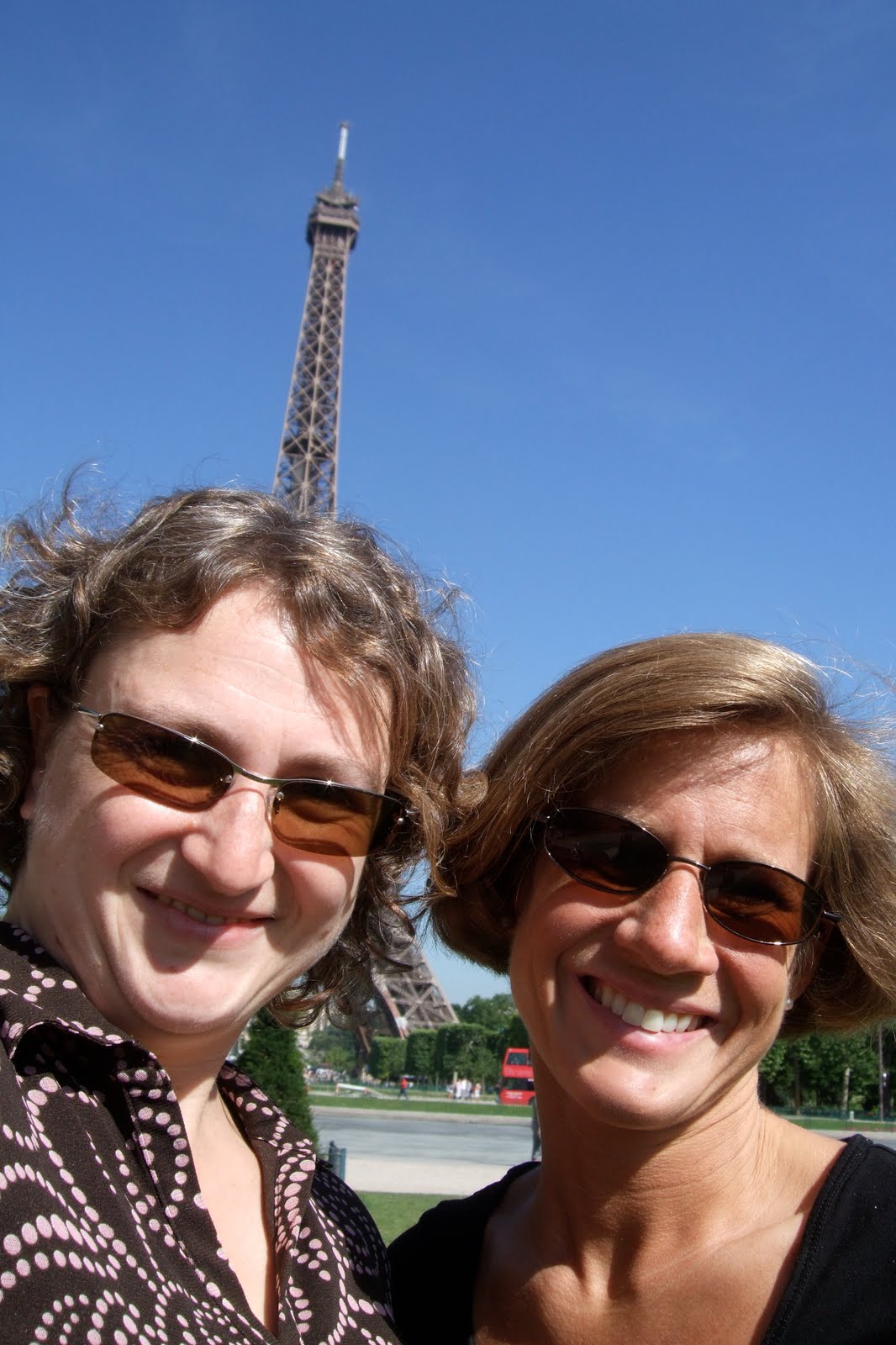
Note that it's impossible to take self portraits at the Eiffel Tower without ending up with the tower sticking out of one's head.


Blue skies at the Sacre de Couer:


Random sculpture in the Tuileries:


The Louvre reflected in John's glasses:


Notre Dame and the Seine:


Some eternal sacrifice back at the Montparnasse Cemetery:


And last but not least, a little bit of friendliness at the Notre Dame Cathedral.


Because nothing says "City of Romance" like Catholicism!


Dillingham Syndrome


A couple of weeks ago, I wrote briefly about our super-fun sailing class on a 40-foot boat in the Ijsselmeer, but I'm not sure I really did justice to the finer points of the experience.

This being the Netherlands, there was a good chance that we were going to experience driving rain, sleet or other forms of meteorological armageddon while out on the water, so we followed the sailing school's instructions and brought a giant duffel bag full of fleece clothes, long underwear, and waterproof everything.

I have to say: there's nothing quite as Dutch feeling as riding one's bicycle to the train station while carrying a backpack loaded down with multiple pairs of knee-high rubber boots.

Other than getting drenched in the process, I suppose.

Much to our surprise and delight, we had gorgeous weather for the entire weekend, so our treasure trove of cold-weather gear stayed neatly packed and stowed.

As I mentioned, the Ijsselmeer is a large freshwater lake created through some tricky Dutch engineering early last century.

It has the same feel as the Great Lakes in the U.S., in the sense that it has waves and wind and its own weather systems.

Its shore is dotted with tiny towns, all of which have marinas for the considerable number of Dutch people who own sailboats or motorboats and spend their weekends out on the water.

As our sailing instructor pointed out, most of the old cities and towns in Holland were built when boats were the primary form of transportation.

As a result, approaching them from the water is a much different experience than driving through suburbs and outskirts and then finally reaching the old city center.

You can also tell how each town's church tower was (and still is) important for navigation, and it was particularly thrilling to hear church bells pealing out across the water

On Friday night, we docked around 10 p.m. in Muiden, a town that boasts 6,700 people, one castle and one bar.

Maybe it goes without saying that John and I haven't spent a lot of time in bars in the Netherlands, and certainly not after 11 p.m.

At the urging of our 25-year-old Irish classmate, we found ourselves drinking more Dutch beer than is advisable for anyone spending the next 48 hours on a boat.

As the evening wore on, we observed with interest that most of Muiden's 6,700 residents were also at this bar.

And through some act of demographic freakery, they were either men over the age of 50, or they were teenagers.

By teenagers, I mean people who look like they're 12, but are drinking beer legally and singing lustily to the Dutch pop songs blaring on the radio.

I find that Europeans are uniformly horrified to learn that Americans can learn to drive when they're 15, but can't drink legally until they're 21.

I see their point, but I find it equally disconcerting to belly up to the bar next to anyone who hasn't hit puberty yet.

The evening had lots of highlights: the unapologetically hideous music was one of them, and the tray of unidentifiable fried things that we inhaled in place of dinner was another.

For me, however, what made all of the watery pilsner worthwhile was learning that certain snarky people describe milk as "Dutch wine".

It's hard to convey properly, but one of the most alarming things about the Netherlands is that Dutch adults are big milk drinkers.

Really big milk drinkers.

It's hard, as a non-Dutch person, to keep my gaping mouth closed when I see a group of banking executives, primarily men over the age of 50, sitting around a boardroom and drinking milk.

Because nothing says business lunch like a big, frosty glass of milk!

In the end, we survived our latest night on the town in recent memory. We even survived our low-level hangovers and managed not to test the limits of the boat's finicky marine toilets.

On Saturday night, we stopped in an even smaller harbor town called Marken, which is famous for its wooden houses and canals in place of streets.


Marken is a good example of what I call Dillingham Syndrome:

If you visit a place that's bizarre to begin with (e.g. Alaska), and then travel to a small town reachable primarily by plane or boat (e.g. Dillingham), you need to be prepared for some really weird shit.


Much to our chagrin, Marken was hosting an event involving loud music and a tent.

For a more peaceful night's sleep, we zipped across the way to Monnickendam, which, at almost 10,000 people, is a thriving metropolis by Dutch standards.

We berthed for the night in a huge marina that gave me an unexpected jolt of nostalgia: it had the joyously familiar feeling of American campgrounds where my grandparents liked to stay, with full hook-ups, coin-op showers, and the same chatty neighbors who come back year after year.

Monday, July 5, 2010

More Absconding


Speaking of absconding, we are spending a lovely long weekend in Paris.

A full rundown is forthcoming, but in the meantime, I'm pleased to report that our general schedule is taking the following form:

  • Wake up;
  • Eat something delicious;
  • Wander through charming neighborhoods;
  • Eat something else delicious;
  • Wander a little bit more, poke around in open-air markets;
  • Stop for a delicious mid-afternoon snack;
  • Go back to the hotel and lounge around before getting ready for dinner;
  • Eat some more deliciousness; and,
  • Sit at an outdoor cafe for the rest of the evening and watch people while drinking a bottle of wine.

Sunday, June 27, 2010

Start Absconding!


My armpits are sore in places I didn't even know I had armpits, thanks to a totally glorious and totally exhausting weekend class we just took called Start Yachting.

But I can't really choke back the bile regarding the use of "yachting" as a verb, so I prefer to think of this more as Start Absconding Via Sailboat to Tiny Island Nations in the Middle of the Pacific.

On a very practical level, this meant spending 2.5 days on a 40-foot boat in the Ijsselmeer, a large, windy, lovely ocean-turned-lake (see ambitious engineering of the Dutch, early 20th century) within sailing distance of Amsterdam.

Other than having to negotiate a complicated and congested system of locks in one of Amsterdam's busiest waterways while steering a 40-foot boat for the first time, it was a perfectly lovely, relaxing, sunny weekend out on the water.

Vanuatu, here we come!


Sunday, June 6, 2010

IVM


Every once in a while, I have a watershed moment when it comes to learning Dutch.

Someone will say something for the third time, or correct me for the seventh, and I will say, "Ohhhhhh...now I get it!"

Another type of watershed comes when I learn something that can be applied easily and correctly in the Dutch emails I write.

Learning "alvast bedankt" — thanks in advance — marked a major improvement in my Dutch correspondence.

But the crown jewel is a simple abbreviated phrase that people use all of the time: ivm, or in verbinding met.

The phrase literally translates to "in connection with," but that fails to demonstrate how amazingly all purpose it is.

There's the literal use: I'm sending this email ivm our upcoming meeting...

It can mean "in reference to" or "with respect to" as in: ivm your recent request for this document...

It can mean "because of": ivm new rules on deposit insurance...

(See what an exciting job I have?)

Basically, any time one needs to express a relationship between two things or slightly passive-aggressive causation, ivm is a three-letter savior.

It's especially handy because it's a descriptive phrase, not a conjunction, which means one doesn't have to change around the word order, add a dependent clause, or do anything else that will cause one's English-speaking brain to explode.

And — here's the best part — it's pre-prepositioned.

Sadly for me, there is not a direct relationship between Dutch prepositions and English prepositions.

For example, you don't ride to work on the train, you ride to work with the train. You don't send a message to someone, you send a message on someone.

It really pains the mind.

It also pains any Dutch listener who is on the receiving end of the wrong linking words.

I don't like to think of the percentage of my Dutch-speaking hours I spend fumbling around ivm (see how handy it is?!) prepositions.

The great thing about ivm? The preposition is already taken care of in a nice little acronym.

All of that is a long way to say that ivm our compulsion to cook elaborate meals using hard-to-find ingredients, we spent yesterday on our semi-annual pilgrimage to the Oriental Superstore in Arnhem.

Its sketchy name aside, we *love* this superstore.

It's the size of a modest American grocery store, which is a marked improvement from most of the tokos* in Nijmegen, which are generally the size of a modest 7-11.

(*I've waxed lovingly about tokos before, but just as a reminder: it's the word the Dutch use to describe tiny grocery stores that carry Chinese, Indonesian, Surinamese, Indian, or other miscellaneously non-Dutch food items.)

This SuperToko is large enough to have the kind of weirdness that makes schlepping all the way to Arnhem on a bus (or via a 3-hour bike ride— not that we were dumb enough to do that last time) worthwhile.

Such as Indonesian-style Kentucky Fried Chicken breading:


I acknowledge that Kentucky Fried Chicken is more than a little bit fraught as an export to Indonesia.

At the same time, I can't help but feel mystified and amused about an American-style chicken recipe adopted wholeheartedly by Indonesians that's been packaged and marketed for sale in the Netherlands.

As far as I'm concerned, it's the sign of a great toko if the Kentucky Chicken section is as large here as it is in grocery stores in Indonesia.